Your Negroni Deserves Better Than a Tumbler: A Field Guide to Glassware That Earns Its Shelf
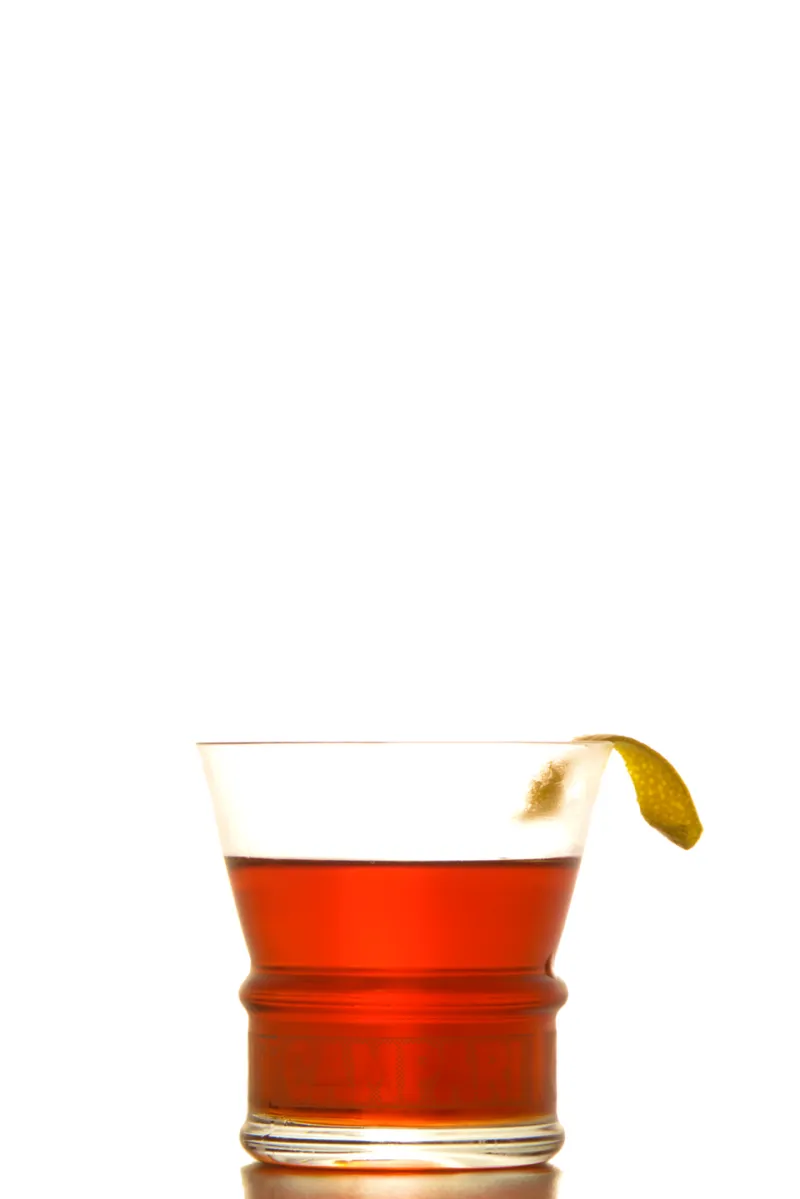
Photo: Matthias Friedlein (www.augustine-bar.de), CC BY-SA 4.0, via Wikimedia Commons
You've done everything right. Equal parts, stirred exactly thirty rotations, one enormous clear cube from the good freezer tray. And then you reach for the glass — a heavy-bottomed rocks tumbler you got free with a bottle of bourbon in 2019 — and the whole production quietly deflates.
Here's the uncomfortable truth: the glass is doing more work than you think. It's the first thing your guest touches, the last thing they see, and the thing their hand will hold for the next forty minutes. It's not packaging. It's an ingredient.
Temperature Is a Glassware Problem
Stemmed glassware exists for a reason, and it's not snobbery. Every time your warm palm wraps around a tumbler, you're running a gentle heat exchange against a drink you worked to keep cold. With a Negroni — a drink served somewhere between 35 and 40 degrees — that matters. A coupe or a Nick & Nora keeps your hand off the liquid entirely, buying your dilution curve an extra twenty minutes of grace.
The old bar logic holds up: delicate, boozy, stirred drinks go up on a stem. If you're serving your Negroni over one big rock, a wide tumbler is defensible. But if you're drinking it neat or up — and you should try it up at least once — the stem isn't a flourish. It's engineering.
The Three Glasses Worth the Cabinet Space
You don't need a home bar stocked like a hotel banquet. You need three workhorses.
The Nick & Nora. Four to six ounces, tall, elegant, slightly retro. Born at the Stork Club and revived by the cocktail renaissance, it's the single most flattering glass for a Negroni up. It makes a small pour feel deliberate — aperitivo, not happy hour.
The Coupe. The workhorse. Negronis, Americanos, Sbagliatos, anything sparkling-bitter. Buy a slightly heavier one — the ultra-thin crystal coupes are gorgeous until you hear that terrible ceramic tink of a rim chipping against your bar spoon.
One genuinely good rocks glass. Not the promotional one. A heavy, hand-blown or thick-based tumbler you actually like holding. This is for the big-ice Negroni, the Old Fashioned, the evening when only one drink will do.
That's it. Three styles, maybe six to eight glasses total, and you can host almost anything.
The Trendy Ones to Politely Decline
The fishbowl-sized balloon glasses that make a standard two-ounce pour look like a mistake? Skip. The matte black tumblers that photograph beautifully and hide the color of a drink whose entire appeal is the color? Hard skip — pouring Campari into a glass you can't see it in is a crime against the whole enterprise.
And the giant, chunky hand-cut crystal goblets that dominate the home goods aisle? They're lovely, but they're for bourbon and ambition, not bitterness. Your Negroni wants to look sharp, not ornate.
Go Thrifting, Not Big-Boxing
Here's the fun part. The best bar glassware in America isn't at the big-box store — it's sitting on a shelf at a Goodwill in Ohio, or a church rummage sale in Connecticut, priced at a dollar a stem.
Hunt for mid-century coupes with gold rims worn soft from decades of use. Look for the heavy, ribbed tumblers your grandmother kept for highballs. Mismatched sets are not a flaw; they're a flex. A row of six slightly different Nick & Noras on a bar cart says I curate. A row of six identical glasses from a big-box shelf says I have a gift card.
A few rules for the hunt: hold every glass up to the light and check for hairline cracks along the rim. Run a finger around the edge — chips hide. And don't overthink the pattern. Bitter drinks are vivid; the glass just needs to frame them.
The Cheapest Upgrade in Your Bar
You can spend forty dollars on a better vermouth or forty dollars on a set of proper coupes, and honestly, the glasses will change your drinks more. Bitterness is visual before it's gustatory — that impossible red-orange glow against clear glass, catching the 6 p.m. light, is half the reason the aperitivo hour works at all.
So stir, strain, and serve it in something worthy. Your guests won't be able to name what changed. They'll just notice that drinking at your place feels different — better, slower, a little more golden.
And isn't that the whole point?