The Art of the Soft Exit: Ending Aperitivo Hour Without a Single Bruised Feeling
Nobody Teaches You How to End a Party
There's a strange asymmetry in entertaining. We obsess over the opening act — the playlist, the cheese situation, the ice program — and then, around ten o'clock, we're left improvising. The candles have burned low, the conversation has gone soft and circular, and you're standing in your own kitchen wondering how on earth to get these lovely people out of your home without a hint of a hint.
Here's the truth nobody says out loud: a gathering that never ends doesn't feel generous. It feels exhausting. The best hosts know that closing an evening is part of the gift. You're not ending the fun — you're framing it. And like everything else in aperitivo culture, it comes down to ritual, lighting, and one well-timed pour.
The Wind-Down Starts Before Anyone Sips
The secret to a graceful exit is that it's engineered hours earlier, not improvised at the door. Aperitivo hour has a natural shape — it's built around the drink itself. A Negroni isn't a nightcap; it's a doorway into an evening, not the whole evening. When you frame your gathering as aperitivo from the start — early invitations, a six o'clock start, a light bite rather than a feast — you've already told your guests when it will end. They just don't know they've been told.
Set the expectation in the invitation itself. "Drinks from six, no need to bring anything but yourself" signals a short, sparkling evening. "Come by around seven" is a blank check. Choose your language like you choose your vermouth: deliberately.
Light Is Your Co-Host
If you learn one trick from restaurant designers, let it be this: lighting does the leaving for you. A restaurant that wants to turn a table doesn't send a waiter over with a speech — it slowly brightens the room, moves the candle, shifts the energy. Your living room can do the same, quietly.
Around the ninety-minute mark, do a small, invisible adjustment. Bring the lamps up a notch. Open the curtains to let the last blue of dusk in. If you have dimmers, this is their moment. Nobody consciously notices the room getting brighter. Everybody subconsciously notices. It's the hospitality equivalent of a yawn — contagious and effective.
Conversely, resist the temptation to go the other way. Killing the lights to signal "last call" reads less like a chic Milanese bar and more like a college house party at 2 a.m. We are not doing that.
The Last Pour Is a Declaration
Every drink has a message in it, and the final round is the loudest. When you're ready to begin the wind-down, pour one last round — a short one — and announce it as such: "Last one, and then I'm kicking you all out." Said with a smile, this line does enormous work. It's warm, it's honest, and it gives everyone permission to finish their glass and go.
What you pour matters too. This is the moment for something lower-proof and shorter — a sherry, a small glass of amaro, an amaro-led nightcap that's more digestivo than aperitivo. The drink itself tells the story: bitter and bright to begin, soft and slow to finish. Your guests will feel the arc even if they can't name it.
The Closing Rituals, In Order
Once the last glasses are down, the choreography begins. Think of it as a sequence, not a single moment:
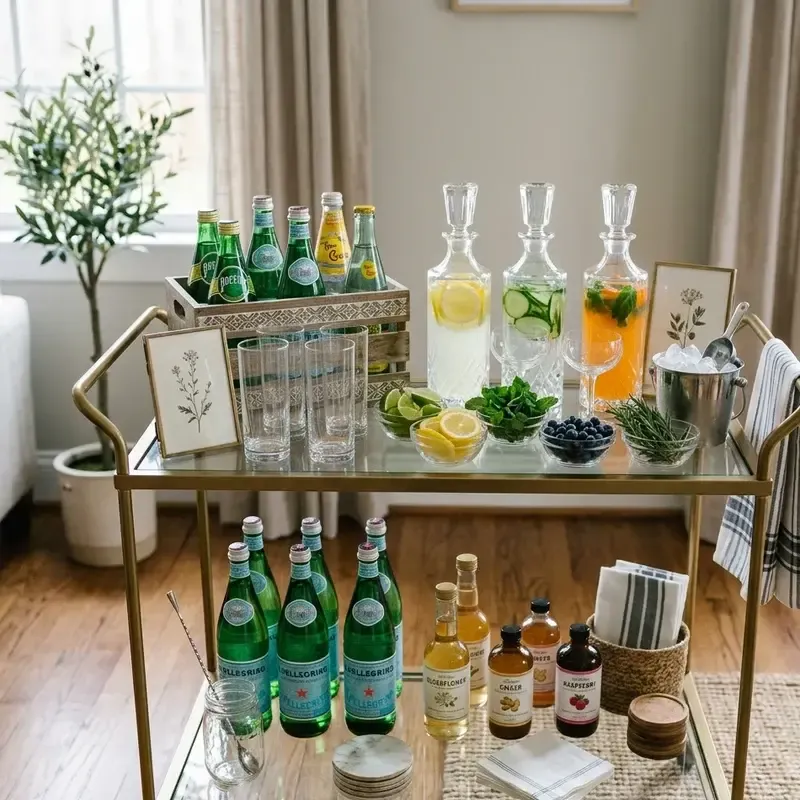
Clear the bar. Start collecting empty glasses and stacking them casually. A bar cart that's visibly winding down is a gentle, wordless signal.
Move the room. If people are settled deep into the sofa, stand up and start tidying — light the candle you blow out at bedtime, fold the throw blanket. Motion is permission. Guests rarely linger past a host who has clearly begun the landing sequence.
Name the ending. Somewhere in here, say it plainly: "This was so lovely — let's do it again soon." The magic phrase "let's do it again soon" converts goodbye from a rejection into a promise. It is the single most useful sentence in a host's vocabulary.
Walk them out. Don't wave from the couch. Get up, gather coats, and escort people to the door. The walk itself is the goodbye — a transition zone between your evening and theirs.
For the Guests Who Won't Take the Hint
There's always one. The friend who launches a new story as you're stacking the final glass, the couple who've made themselves remarkably comfortable. For these beloved cases, escalate gently: move to the hallway, keep your body angled toward the door, and deploy the warmest possible version of the truth — "I have to be up early, but I'm so glad you came." It doesn't have to be true. It has to be said with conviction.
And if all else fails, the nuclear option that still feels gracious: "Stay, I just need to start cleaning up." Nobody on earth will keep a host company while they scrub the Negroni glasses.
End on Your Terms, End on a High
The goal was never to make people leave. It's to make them leave wanting more — the only reliable way to guarantee a next invitation gets accepted. An evening that ends a little early, on a high note, with everyone warm and slightly bitter-glassed, is remembered as perfect. An evening that limps to midnight is remembered as long.
So light the candles at six, pour the last round at nine, and walk your people to the door with both hands. The Negroni taught us that the best things are brief and bittersweet. Your parties should be no different.