From Hotel Bar to Bowling Alley: The Negroni's Great Democratic Descent
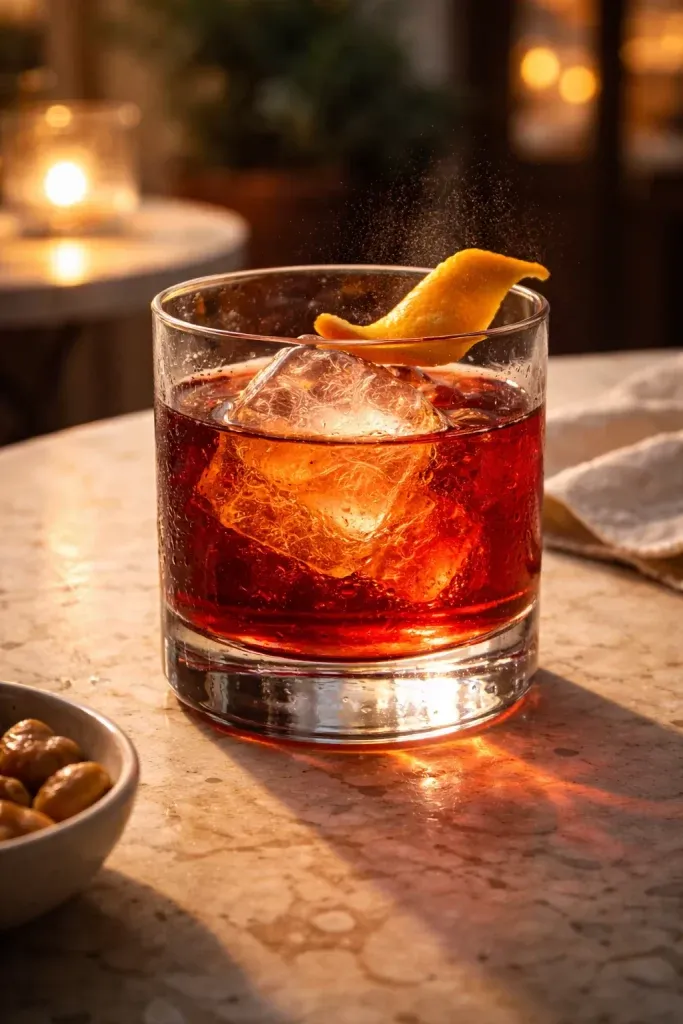
Photo: negroni cocktail dive bar rocks glass neon, via www.cavatelli.nl
There's a moment I keep thinking about from earlier this spring. I was in a bowling alley in Dayton, Ohio — the kind with carpet that fights back and a bar that hasn't updated its menu since the Reagan administration, except for one laminated insert. On that insert, between a Long Island and something called a 'Cherry Bomb,' sat a Negroni. Eight dollars. Served in a rocks glass with one sad, perfectly functional ice cube.
It was, I have to tell you, delicious.
The Drink That Left the Building
For years, the Negroni lived where we expected it to: behind marble bars, in hotel lounges with names like 'The Library' or 'The Study,' garnished with an orange peel cut so precisely it looked machine-made. It was a drink with a dress code, even if nobody wrote one down.
That era is over, and good riddance. The Negroni has done something most classics never manage — it has gone genuinely, messily mainstream. It's at airport bars in Phoenix. It's at biker taverns outside Milwaukee. It's at the dive near the bus depot where the well gin is questionable and the Campari, notably, is not. The recipe is three ingredients and one instruction: stir it cold. There is nowhere that can't make it, and increasingly, nowhere that doesn't.
Why This Is Good News, Not Bad
I know the reflex. When a beloved underdog goes wide, the instinct is to mourn. We did it with bourbon. We did it with mezcal. We act like popularity dilutes a thing, as if flavor has a seating chart.
But a cocktail's health isn't measured by how exclusive it is. It's measured by whether people will still be stirring it in fifty years. And the drinks that survive — the Martini, the Old Fashioned, the Manhattan — all share one trait: they escaped their origin stories. They belong to everyone now. The Negroni is joining that pantheon, one bowling alley at a time.
Gatekeeping, meanwhile, has never saved a drink. It has only embalmed one.
What I Learned in the Field
I started paying attention to where Negronis actually get poured, and the findings were humbling. A roadhouse in West Texas served one with a splash of grapefruit juice the bartender called 'my little secret' — a heresy that tasted like a summer evening. A strip-mall sushi spot in Sacramento built theirs with a Japanese gin and didn't apologize for it. A sports bar in Tampa had it on tap, pre-batched, in a keg, and honestly? The dilution was better than half the hand-stirred versions I've paid eighteen dollars for.
The pattern across all of them: nobody was precious. The drink was simply there, available, part of the landscape. That's what maturity looks like for a cocktail. It stops being a statement and starts being a habit.
The Bus Stop Standard
Here's the test I propose, half seriously: could you order a Negroni somewhere you'd also reasonably wait for public transportation? If the answer is yes in your city, the drink is alive. Not 'trendy' — alive. Trendy drinks need the right room, the right lighting, the right crowd. Living drinks just need ice and three bottles.
The Negroni passes everywhere I've tried it. That's not a decline. That's a classic settling into its bones.
So the next time you see one on a menu that surprises you — the tavern, the bowling alley, the airport lounge — order it. Raise the slightly chipped rocks glass. You're not slumming. You're watching history do exactly what it's supposed to do: spread.